Wednesday, May 27, 2015

#SummerList

The longer I go without blogging, the harder it is to start... :)

Summer is one of the best perks of being a teacher. I sleep in a bit, go for a walk, then tackle my to-do list at my own pace. I use the summer time to really think through activities I want to add to my curriculum, changes I want to make, books to read, etc. For accountability, I've decided to blog my list here rather than write it down in my handy, dandy, little notebook. :)


Books I plan to Read (or Re-Read):
I'm sure there are others, so I'll update this list as I read them :)


Things I want to explore
  • Better integration of the Chromebooks (1:1)
    • Exploring Google Forms for Quick Formative Assessment
    • Learn to use/integrate various online tools such as Plot.ly, Desmos, and StatKey in my classroom
    • Create some Kahoot games to use for review activities
    • Spend some time playing with Chrome apps that might be useful, such as a flashcard app, etc.
  • Work on more Free Response writing - this is a weakness due to my class sizes... grading 100+ of these is a killer!
    • Integrate whiteboarding activities
    • Use mistakes and error analysis
    • Expose students to the rubrics more

To be honest, I was pretty pleased with how things went in my classes this year, but I always have room for improvement. A lot of the things I've scribbled on my list are minor tweaks, but tweaks that I feel can make a huge impact in my classroom.

What's on your #SummerList?

Monday, May 25, 2015

List of List of Websites for Math Teaching Resources

In less than a year on the "MathTwitterBlogosphere," I've collected tons of great resources in Diigo lists, which I've now exported to blog posts here. Some ideas and lessons on these lists are ones I've used already in my middle school math classes; others are on my summer research list.

Here's how I've sorted websites (sometimes arbitrarily):

Math Websites: Specific Lessons
Math Websites: Classroom Culture & Mathematical Practices
Math Websites: Professional Development and Teaching Ideas
Math Websites: Meaty Problems
(Not Just) Math Websites: Games & Puzzles
Math Websites: Educational Technology

And here's one more I forgot to add originally! This is a list of sites I made for my students so they could investigate math in different contexts that interested them:

Math You Can See: Art, Nature, Patterns, Society, and More

(Not Just) Math Websites: Games & Puzzles

Some math games & puzzles are also included in my Meaty Problems list.

Math Websites: Specific Lessons

GOOD SOURCES FOR MULTIPLE LESSONS

RATIO AND PROPORTIONAL RELATIONSHIP LESSON

NUMBER SYSTEM LESSONS

EXPRESSIONS AND EQUATIONS (ALGEBRA) LESSONS

GEOMETRY LESSONS

STATISTICS AND PROBABILITY LESSONS

LOGIC/PROOF LESSON

Math Websites: Meaty Problems

See also my Games and Puzzles list.


GENERAL PROBLEMS AND PUZZLES (ordered very roughly by likely age of interest, youngest to oldest)

PROBLEMS AND PUZZLES FOR PARTICULAR TOPICS AND SKILLS (ordered roughly by age, youngest to oldest)

Math Websites: Educational Technology

ONLINE MATH TOOLS STUDENTS CAN USE

ONLINE MATH TOOLS & RESOURCES FOR TEACHER PREP

ONLINE RESOURCES TO HELP STUDENTS UNDERSTAND MATH CONCEPTS

OTHER INTERESTING MATH STUFF ONLY AVAILABLE ONLINE

Math Websites: Professional Development and Teaching Ideas

Here's a list (exported from Diigo) of some posts and resources I wanted to be able to come back to (often for the links within those posts as well!). The division between this list and some others I've made, especially Classroom Culture and Mathematical Practices, is rather arbitrary.

FEEDBACK AND ASSESSMENT

LEARNING ABOUT TECHNOLOGY

SPECIFIC MATH TOPICS

LESSON DESIGN

OTHER CLASSROOM TEACHING PRACTICES

OTHER/NOT YET SORTED:

Math Websites: Classroom Culture & Mathematical Practices

Here's a list (exported from Diigo) of some posts and resources I wanted to be able to come back to (often for the links within those posts as well!). The division between this list and some others I've made, especially Professional Development and Teaching Ideas, is rather arbitrary.

BUILDING CONFIDENCE, A GROWTH MINDSET, AND A SAFE CLASSROOM CULTURE

REASONING, SENSE-MAKING, AND PROBLEM SOLVING

HOMEWORK AND TEST REVIEW

FUN AND GAMES IN MATH CLASS

POSTERS

OTHER/NOT SORTED YET:

Tuesday, May 19, 2015

Quadratic Functions project

Thanks to @SweenWSweens and his M&M Catapult Project (explained here and here and updated here), we are ending the quadratic functions unit in my 10th grade class with a bang. Well, a whooooosh, but you know what I mean. Kids had a ton of fun with this activity and it gave great practice for writing and solving quadratic equations. The basic idea (but really, you should check out Sean's posts) is that groups launch an M&M and measure the horizontal distance traveled and approximate the vertical distance traveled by using the time, putting this together to create a quadratic function that models this relationship. Then, they apply this model when the launcher is placed a given height above the ground to figure out where to place a target.

First of all, Sean was super helpful, walking me through the lab and giving me great tips on how to adapt it for my students. Love that #MTBoS. My project description and follow-up questions are here.

Here are the changes that I made to Sean's awesome plans and why:
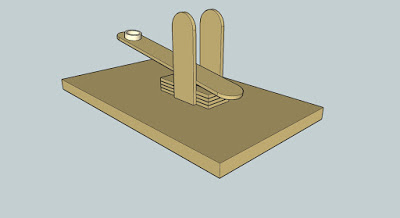
  1. I let kids build their own launchers. I shared Sean's basic design (pictured at right), but let them tweak it or do their own thing altogether. It actually took kids only about 20 minutes using our engineering lab, which had all of the supplies already, except for clothespins, as opposed to the few hours I would have spent making all of them and then dealing with kid complaints that their launcher wasn't good. Next time, I will do this again, but will also share Sean's updated design, which I did not see in time (below).
  2. Here is what my kids built (most just did the basic design, a few went nuts and did their own thing):


  3. Little direction was provided about lab technique or how to find the equation relating the height vs. horizontal distance. We did discuss the equation relating vertical distance traveled and falling time, but next year, I will do a better job of integrating this concept into earlier problems so that students can generate this idea themselves. What I liked as a result of giving less structure:
    • Students incorporated other topics, which I did not anticipate. A few groups did statistical analysis to look for outlier data, which was awesome since that was a concept learned way back in September. Others compared lab protocols from different science classes and their applicability to this project.
    • There was much more variety in approaches, which allowed for richer discussions within and between groups and more connections made. Some groups used the vertex, some used intercepts, and others used quadratic regression on desmos to generate equations. There was likewise diversity in how to change the model to incorporate the new starting height for the final launch. 
    • The intellectual rigor was higher - students had to figure out what to do and then for their write-up, remember and reflect on their approach.
  4. I used some class time after the activity for groups to whiteboard their approaches and then share out with the class and get feedback on their thinking. I also used 15 minutes the day that the write-ups were due for students to peer edit each other's work. The goal was to have more cross-pollination of ideas and connections made, as well as a chance to justify their own and critique each other's reasoning. I'm hoping that this also helped to produce higher quality final products and deeper understanding. Next year, I hope to run a more structured peer-editing process with specific questions for students to address.
  5. More individual accountability - students were asked to divvy up points to their group members and describe each person's contributions as well as complete individual follow-up questions. I need to think about this more to see if I think this overall contributed to students' learning and experience with this project and helped or hurt their collaboration.
And now, more pictures!!

Building the launchers:


Gathering data:


Final launch day:


A few student whiteboards:


Once again, huge thanks and shoutout to Sean for creating this!! it ended up being a great project for this unit. Students had a blast, but were also appropriately challenged. 

Feedback from students: